Form W-9: Request for Taxpayer Identification Number and Certification
Internal Revenue Service · Rev. March 2024
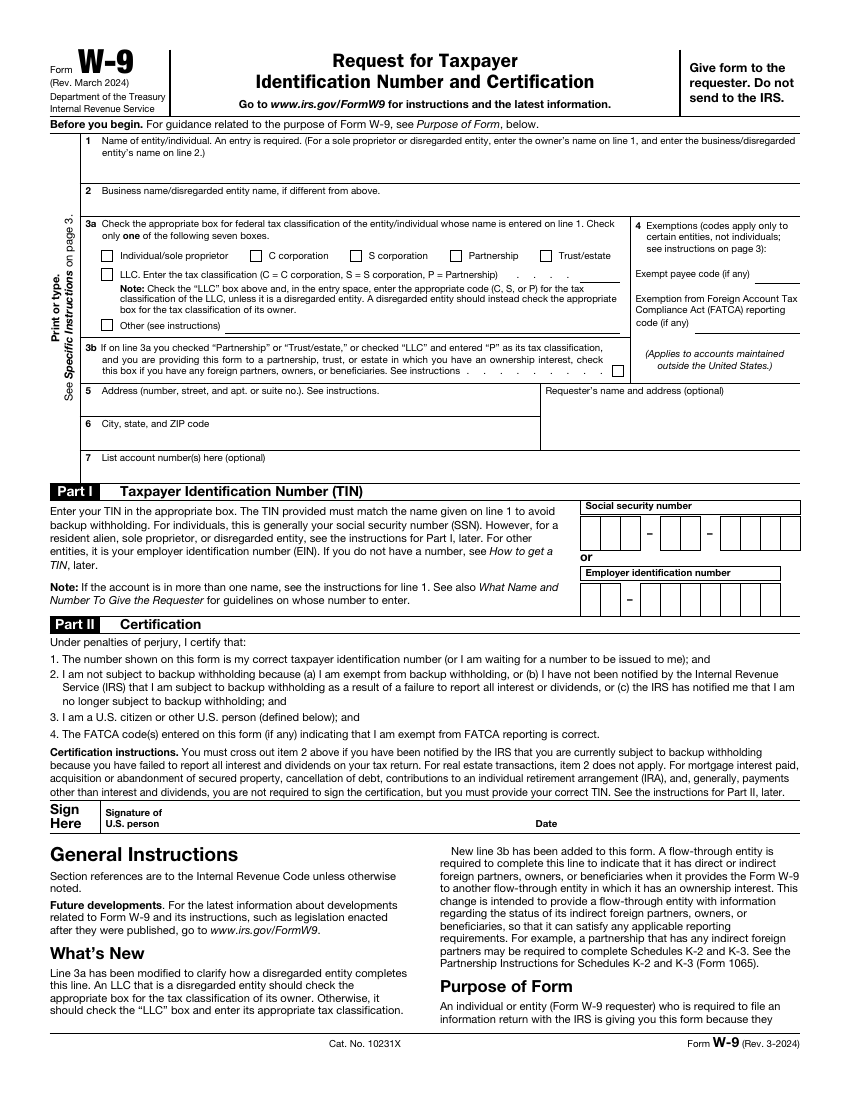
About Form W-9
Form W-9 is how a person or business gives their taxpayer identification number to someone who will pay them. You do not file it with the IRS. You hand it to the client, bank or platform that asked, and they use it to report what they paid you.
If you work for yourself, sell through a marketplace, earn interest or rent out property, you will probably be asked for one. Filling it in takes a few minutes: your name, how you are taxed, your address and your number, then a signature.
Who needs it
Freelancers, independent contractors, landlords and other payees who are asked for a W-9 by a client, bank or payer. You give it to the requester. Do not send it to the IRS.
When to use it
- You are an independent contractor or freelancer and a client asks for your taxpayer ID.
- A bank, broker or other payer asks you for a W-9.
- You receive rent, royalties or other income that the payer must report to the IRS.
When not to use it
- You are an employee. Use Form W-4 instead.
- You are a foreign person. Foreign persons generally use a W-8 form, such as W-8BEN.
- Do not send the W-9 to the IRS. Give it to the person who asked for it.
Parties involved
- Requester (the payer): The client, bank, platform or other business that pays you. It asks for the form, keeps it and uses your number on information returns such as Form 1099.
- You (the payee): You give your correct name and taxpayer number and certify that they are right. You stay responsible if the details are wrong.
- The IRS: It does not receive the form from you. It receives the payer's information return and matches it against the number you gave.
Key terms
- TIN (taxpayer identification number): The number the IRS uses to identify you: a Social Security number, an employer identification number or an individual taxpayer number.
- EIN: A nine-digit number for businesses, issued by the IRS.
- Backup withholding: Tax the payer must hold back from your payments when you do not give a valid number. The rate is set by the IRS.
- Exempt payee code: A code for certain payees, such as some corporations, that are not subject to backup withholding.
- Disregarded entity: A business, often a single-member LLC, that is treated as its owner for federal tax.
How to fill it in
- Enter your name: Line 1 is your name as shown on your tax return. If you are a sole proprietor or single-member LLC with a business name, put that on line 2.
- Choose your tax classification: On line 3a, check only the one box that describes you, for example individual or sole proprietor, C corporation, S corporation or partnership.
- Add exemptions if they apply: Line 4 is only for certain payees and reporting codes. Leave it blank if the instructions do not apply to you.
- Enter your address: Fill in your street address on line 5, and your city, state and ZIP code on line 6.
- Enter your taxpayer ID: In Part I, enter your Social Security number, or your Employer Identification Number if you are a business.
- Sign and date: In Part II, sign and date the certification, then give the form to the person who asked for it.
Before you start
- Enter the name on line 1 exactly as it appears on your tax return.
- Check only the one federal tax classification box that applies to you.
- Sign and date Part II only where the form asks for a certification.
Questions
What is Form W-9?
Form W-9 is how you give your correct taxpayer identification number (TIN) to a person or business that will pay you, so they can report what they paid you to the IRS.
Who asks me to fill in a W-9, and where does it go?
A business or person who pays you, such as a client, a bank or a platform, asks for it. You give the completed form to them, not to the IRS. They keep it to prepare an information return such as Form 1099.
Do I write my SSN or my EIN on a W-9?
Individuals and sole proprietors normally use their Social Security number. An entity such as an LLC or corporation uses its employer identification number. A sole proprietor who has an EIN may use either one.
What do I tick on line 3 (federal tax classification)?
Tick the one box that matches how you are taxed: individual or sole proprietor, C or S corporation, partnership, trust or estate, or LLC with its tax code. A single-member LLC that is not taxed separately from its owner is usually shown as the owner's type.
What happens if I do not give the payer a W-9?
The payer may have to withhold tax from your payments, called backup withholding, until they have a valid taxpayer number from you.
I live outside the United States. Do I use a W-9?
No. The W-9 is for U.S. persons. A foreign person normally gives the payer a Form W-8 instead, such as W-8BEN for an individual.