Form 941: Employer's Quarterly Federal Tax Return
Internal Revenue Service · Rev. March 2026
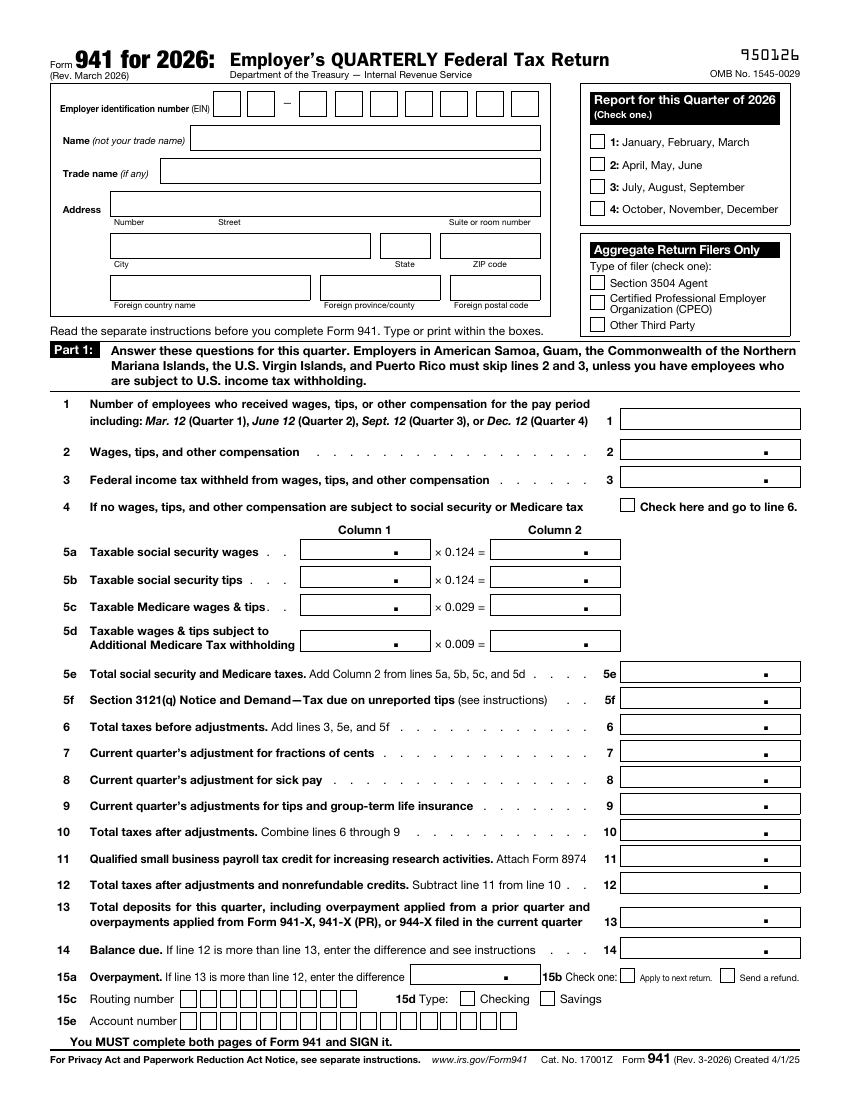
About Form 941
Form 941 is how employers report payroll taxes to the IRS every quarter. It ties together wages paid, income tax withheld from employees and the Social Security and Medicare taxes owed.
Part 1 covers the totals for the quarter, Part 2 shows how and when you made deposits, and the rest covers closed businesses, a third-party designee and your signature.
Who needs it
Employers who pay wages and withhold federal taxes. Household and agricultural employers generally file different returns.
When to use it
- You paid wages to employees and withheld federal income tax or Social Security and Medicare tax.
- You must report the quarter even if you paid fewer wages than usual.
- You need to correct or complete your quarterly employment tax reporting.
When not to use it
- You only pay household employees. Those taxes are generally reported with your personal return.
- You are reporting yearly farm payroll. Employers in agriculture generally use Form 943.
- You are giving a worker their yearly wage statement. That is Form W-2.
Parties involved
- Employer: Prepares, signs and files the return and makes the deposits.
- Employees: Their wages and withheld taxes are what the form reports.
- Third-party designee: A person you allow the IRS to discuss the return with.
- Paid preparer: Signs if they prepared the return for payment.
Key terms
- EIN: The nine-digit number the IRS gives a business.
- Withholding: Tax the employer takes out of wages and pays to the IRS.
- Deposit: A payment of payroll tax made during the quarter.
- Quarter: A three-month period: January to March, April to June, July to September or October to December.
- Semiweekly schedule: A rule that requires deposits twice a week for larger payrolls.
How to fill it in
- Identify your business: Enter your EIN, name, trade name and address, and check the box for the quarter you are reporting.
- Report wages and withholding: In Part 1, enter the number of employees, total wages, tips and other compensation, and federal income tax withheld.
- Report Social Security and Medicare: Enter the taxable wages and tips subject to those taxes and let the form work out the tax.
- Add adjustments and credits: Enter any adjustments and the credits that apply to your business, then total your tax.
- Compare with your deposits: Enter the deposits you made and find the balance due or overpayment.
- Show your deposit schedule: In Part 2, say whether you deposit monthly or semiweekly and list the amounts as the form asks.
- Sign and date: Sign in Part 5. Add the paid preparer section if someone prepared it for you.
Before you start
- Have your employer identification number and payroll totals for the whole quarter ready.
- Tick the right quarter at the top. The wrong box is a common mistake.
- Make sure the tax you report matches the deposits you made during the quarter.
Questions
What is Form 941?
Form 941 is the quarterly return employers file to report wages paid, federal income tax withheld, and both the employer and employee shares of Social Security and Medicare taxes.
How often do I file Form 941?
Every quarter, for each quarter you are required to file.
When is it due?
Generally by the last day of the month after the quarter ends. The instructions show the exact dates.
Is a deposit the same as filing?
No. Deposits are payments. Form 941 is the return that reports and reconciles them.
Do I file it if I had no wages?
Generally you still file unless you have told the IRS that you will not owe employment taxes.