Form 8822: Change of Address (For Individual, Gift, Estate, or Generation-Skipping Transfer Tax Returns)
Internal Revenue Service · Rev. February 2021
About Form 8822
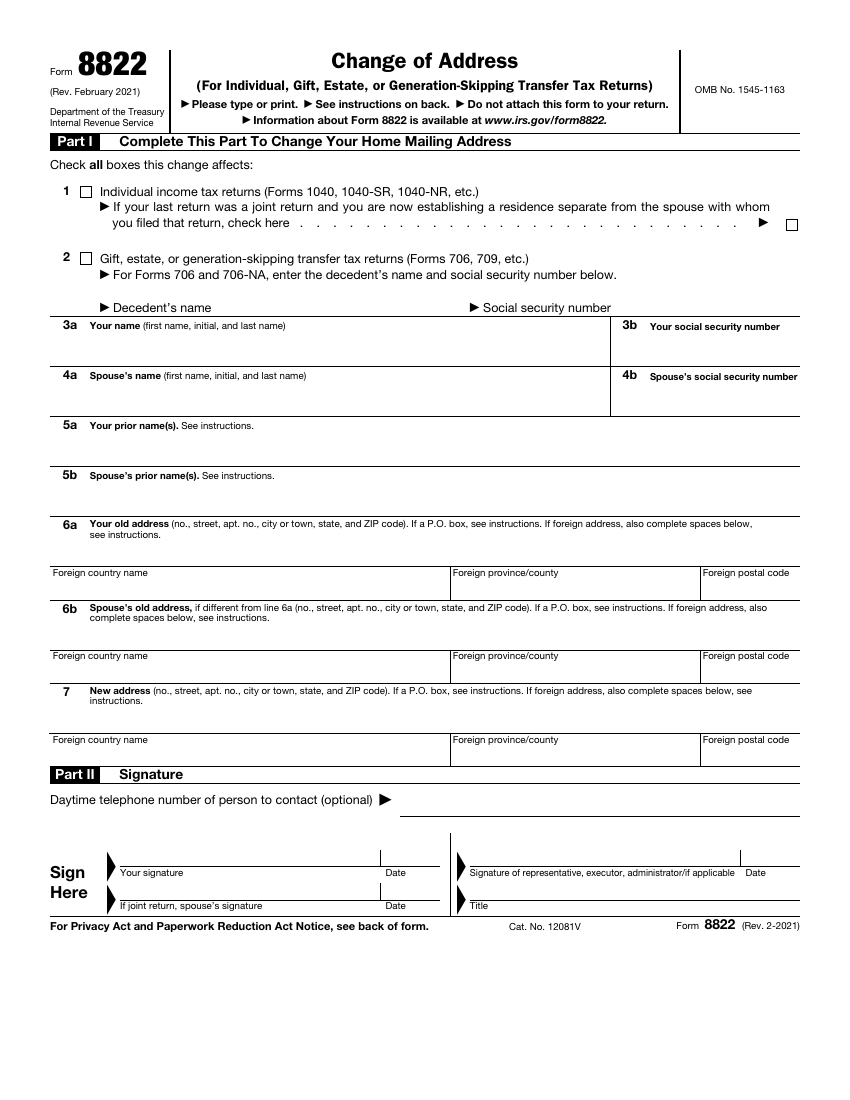
Form 8822 changes the address the IRS has on record for your individual and related transfer tax matters. Filing it keeps IRS letters and refunds from going to your old address.
Part I covers what is changing and your old and new addresses, and Part II is the signature. The instructions on the back list where to send the form.
Who needs it
Individuals who have moved, and anyone changing the address the IRS uses for their personal tax, gift or estate tax filings.
When to use it
- You moved and want the IRS to use your new mailing address.
- You are changing the address for gift, estate or generation-skipping transfer tax returns.
- You are separating from a spouse you filed jointly with and need a separate address.
When not to use it
- You are changing a business address. Businesses use Form 8822-B.
- You need a transcript of a return. Use Form 4506-T.
- You are filing your yearly return. Use Form 1040.
Parties involved
- Taxpayer: Reports the new address and signs the form.
- Spouse: Signs too if the change applies to both.
- IRS: Updates the address on its records.
Key terms
- Mailing address: The address where the IRS sends your notices and refunds.
- Prior name: A name you used on earlier returns.
- Joint return: A single tax return filed by two spouses.
- Gift tax return: A return that reports gifts, such as Form 709.
How to fill it in
- Choose what the change affects: Check the box for individual income tax returns, for gift, estate or generation-skipping transfer tax returns, or both.
- Enter your names and numbers: Add your name and Social Security number, and your spouse's if it applies, plus any prior names.
- Enter your old address: Give the address the IRS has on file, as shown on your last return.
- Enter your new address: Give the new mailing address. A P.O. box is allowed in the situations the instructions describe.
- Sign and date: In Part II, sign and date. A spouse signs too when the change applies to both.
- Mail it to the right place: Use the "Where to file" list in the instructions to find the address that matches your situation.
Before you start
- Do not attach this form to your tax return.
- Check every box that the change affects on the first lines of Part I.
- If you were filing jointly and are now living apart, the form has a box to tell the IRS.
Questions
What is Form 8822?
Form 8822 tells the IRS that your home mailing address has changed, so notices and refunds for individual, gift, estate and generation-skipping transfer tax matters reach you.
Do I send it with my return?
No. Do not attach it to your return. Mail it separately.
Where do I send it?
The back of the form lists addresses based on where you live and what the change covers.
Do both spouses need to sign?
If the change applies to both of you, both sign.
Is this for a business?
No. Business address changes use Form 8822-B.