Form 8275: Disclosure Statement
Internal Revenue Service · Rev. August 2013
About Form 8275
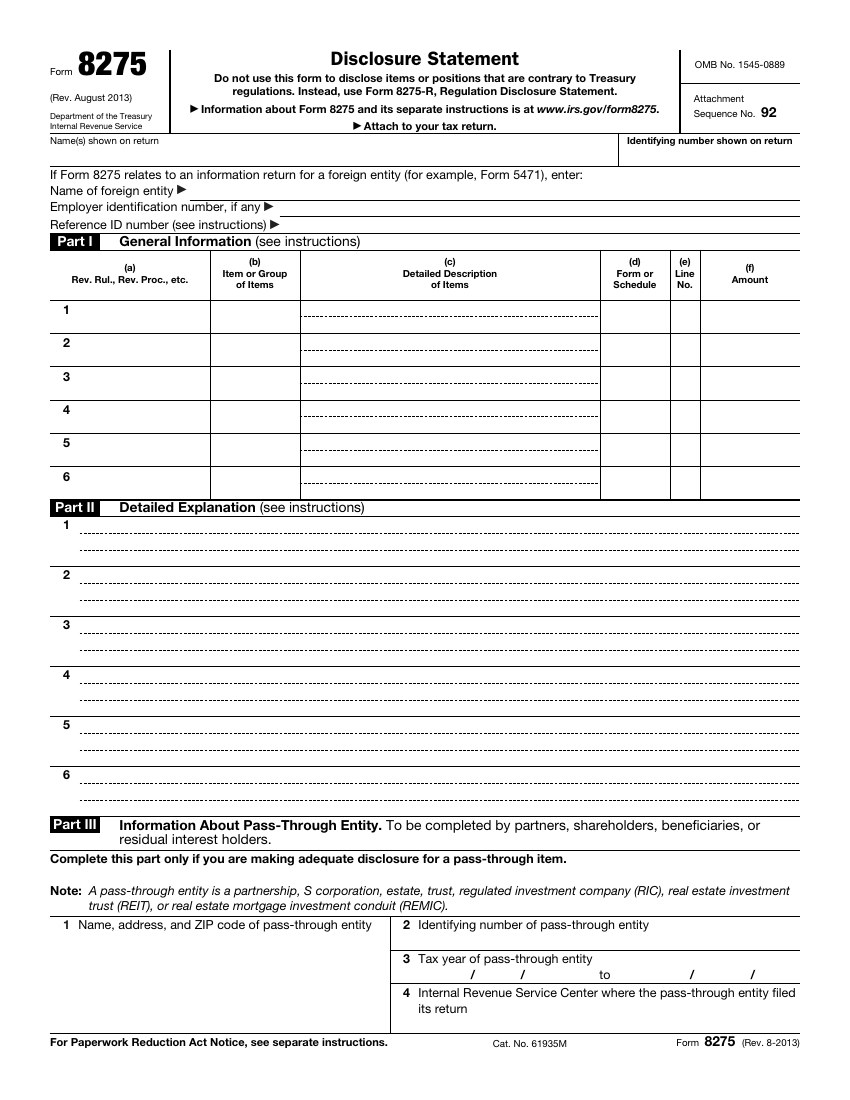
Form 8275 is a disclosure form that accompanies a tax return. It tells the IRS about positions you took so that the return is treated as adequately disclosed.
Part I summarizes the items, Part II gives a detailed explanation, Part III covers pass-through entities and Part IV holds other explanations.
Who needs it
Taxpayers and tax preparers who take a position on a return that has a reasonable basis but is not clearly supported, and who want to disclose it.
When to use it
- You are disclosing a tax position that has a reasonable basis to avoid penalties.
- You need to explain an item on a return in detail.
- A pass-through entity needs to give disclosure information for its owners.
When not to use it
- Your position is contrary to a regulation. Use Form 8275-R.
- You are only filing a regular return. Use Form 1040.
- You are changing your address. Use Form 8822.
Parties involved
- Taxpayer: Prepares the disclosure and signs the return it is attached to.
- Preparer: May help prepare the disclosure.
- IRS: Reviews the disclosure with the return.
Key terms
- Disclosure: A statement that explains a position taken on a return.
- Pass-through entity: A business such as a partnership or S corporation whose income passes to its owners.
- Reasonable basis: A level of support for a position that is higher than a weak argument.
- Form 8275-R: The disclosure form for positions that go against regulations.
How to fill it in
- Identify the return: Enter the names and identifying number shown on the return and any foreign entity details the form asks for.
- List the items in Part I: For each item, enter a description, the form and line or schedule, the amount and any ruling or authority you rely on.
- Explain in Part II: Give a detailed explanation of the facts and the position you took.
- Complete Part III if it applies: If the return belongs to a pass-through entity, enter the details the form asks for.
- Add Part IV explanations: Use Part IV for any extra explanation not covered above.
- Attach to your return: File the completed form together with your tax return.
Before you start
- Do not use Form 8275 for positions that are contrary to Treasury regulations. Use Form 8275-R instead.
- Attach the form to the tax return it relates to.
- Describe each item clearly so the IRS can tell what position you took and why.
Questions
What is Form 8275?
Form 8275 lets you disclose a position you took on a tax return, so you can avoid certain accuracy-related penalties. It is attached to the return it relates to.
Does it replace my return?
No. It is attached to your return.
When do I use 8275-R instead?
When your position is contrary to a Treasury regulation.
Is a separate form needed for each item?
You can list several items in Part I, and the instructions explain how to group them.
Who signs it?
The form attaches to the return, which is signed by the taxpayer.